Back & joint care,without the guesswork.
Backsurgery Concierge connects U.S. patients with vetted spine and orthopedic specialists in Tijuana. One coordinator handles your treatment plan, travel, and stay — start to finish.
Not "cheaper care abroad." A specific, licensed, well-located option.
This is the part most sites skip. Here's the honest reasoning behind treating in Mexico, and in Tijuana specifically.
Why Mexico
Mexico has built a mature, physician-led private healthcare sector that treats a large volume of U.S. patients every year — this isn't a fringe option.
- Costs are typically a fraction of equivalent U.S. private-pay pricing
- Many specialists trained or certified internationally, including in the U.S.
- Shorter scheduling timelines than many U.S. private and insurance pathways
Why Tijuana specifically
Tijuana is one of the most established medical-travel hubs in Mexico, largely because of one practical fact: it sits directly on the USA border.
- Walking distance to San Diego, California — no domestic flight needed
- A dense, competitive cluster of specialty clinics, used to treating U.S. patients
- Easier for a companion or family member to join you for the trip
Spine, joint, and regenerative treatment options
Every case starts with the same honest question: does this actually need surgery, or is there a lower-risk path worth trying first? Your intake call is built around answering that. Our surgeon treats both spine and orthopedic joint conditions.
Most back pain improves conservatively
According to Mayo Clinic, most acute back pain improves within about four to six weeks with conservative management — anti-inflammatory medication, heat therapy, and gentle activity.
Learn more →Movement over bed rest
Light activity like daily walking is generally recommended over strict bed rest, which can actually prolong recovery and reduce circulation to healing tissue.
Learn more →Managing acute inflammation
Ice packs and appropriate over-the-counter anti-inflammatory medication, used as directed, are commonly recommended in the first two days after an acute flare-up.
Learn more →Before surgery is considered
For persistent radicular pain (sciatica) or structural issues, a structured step-up approach — physical therapy, cortisone injections, radiofrequency ablation, or targeted nerve stimulation — is often tried first, with high success rates.
Learn more →Preventing re-injury
Core strengthening, proper lifting technique (bending at the knees, not the waist), and ergonomic adjustments at work and home help prevent the problem from coming back.
Learn more →If conservative care doesn't resolve it
When symptoms persist despite this step-up approach, or there's a clear structural cause, surgical evaluation becomes the next honest conversation to have.
Learn more →Herniated & bulging discs
Disc material pressing on nearby nerves, often causing radiating pain, numbness, or weakness down an arm or leg.
Learn more →Degenerative disc disease
Gradual wear of the spinal discs that reduces cushioning between vertebrae — a leading reason patients look into regenerative options.
Learn more →Spinal stenosis
Narrowing of the spinal canal that can compress nerves, frequently seen with age-related changes to the spine.
Learn more →Minimally invasive discectomy
Removal of the portion of a disc pressing on a nerve, performed through a small incision to reduce recovery time.
Learn more →Spinal fusion
Joining two or more vertebrae to stop painful motion at a damaged segment, typically reserved for more advanced cases.
Learn more →Stem cell & PRP therapy
Image-guided injections aimed at supporting the body's own repair response, as an alternative or complement to surgery.
Learn more →Shoulders
Rotator cuff tears, impingement, and instability treated through arthroscopic repair or reconstruction.
Learn more →Hands & wrists
Carpal tunnel syndrome, tendon repair, and joint reconstruction for hand and wrist conditions.
Learn more →Knees
Meniscus tears, ligament reconstruction (ACL/PCL), and cartilage damage evaluated for repair or replacement.
Learn more →Arthroscopic surgery
Minimally invasive joint surgery performed through small incisions, used across shoulders, elbows, and knees.
Learn more →Stem cell & PRP therapy
Joint-preserving injections aimed at supporting tissue repair and delaying or avoiding replacement surgery.
Learn more →What the treatment involves
Our regenerative-medicine partner uses mesenchymal stem cells — including placental-derived cells — to support the body's own tissue repair process. These treatments are used for a range of autoimmune, neurological, and musculoskeletal conditions, and are delivered under specialist supervision rather than surgically.
Cell sources used by our partner clinics
- 1
Why patients consider it
Degenerative disc disease, chronic lower-back pain, and joint osteoarthritis are among the more established uses for regenerative injections — often tried before surgery.
- 2
Why it's more available here
Mexico has a dedicated regulatory framework for cellular therapy under COFEPRIS, while many stem cell uses remain limited to clinical trials in the U.S.
- 3
Not everyone qualifies
Candidacy is decided after a specialist reviews your imaging and history — we'll tell you plainly if surgery is the better fit.
- 4
Follow-up is built in
Patients are typically offered check-ins for up to twelve months after treatment to track how they're responding.
Regulations and facility standards, explained plainly
National and international medical regulations that apply to your care, and what we personally check before referring a patient anywhere.
COFEPRIS
Mexico's federal health regulator (Comisión Federal para la Protección contra Riesgos Sanitarios) — Mexico's equivalent to the FDA. It licenses medical facilities, sets safety protocols, and authorizes which clinics can legally perform specific procedures.
Facility standards
Before referring a patient, we confirm current COFEPRIS licensing, review the facility's surgical outcomes reporting where available, and confirm English-language capability on staff.
Coordinating with your U.S. doctor
You'll receive full medical records and imaging in a format you can share with your primary care physician back home — nothing gets siloed on one side of the border.
Questions worth asking any clinic
Is the facility COFEPRIS-licensed for this specific procedure? Who administers anesthesia? What's the follow-up plan if something needs attention after you're home?
Where you'll actually be treated
The hospitals and surgical facilities we work with in Tijuana, and what to look for in terms of accreditation, equipment, and standards.
The specialists behind your treatment plan
Board-reviewed, COFEPRIS-licensed physicians coordinating your care in Tijuana. Swipe or use the arrows to see everyone on the team.
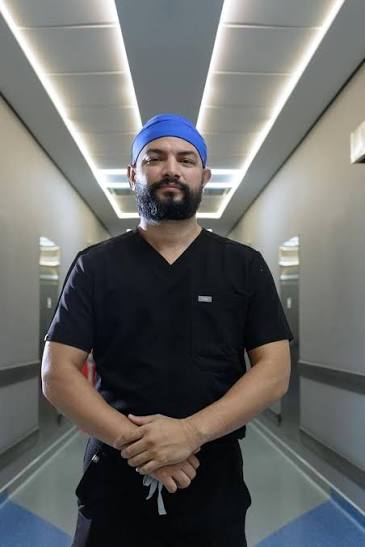
Dr. Jorge Alberto Pérez Terrazas
Orthopedic & Trauma Surgeon — Spine Surgery Specialist
- Specialization: Minimally invasive and endoscopic spine surgery; orthopedic care for spinal and joint conditions.
- Medical education: Autonomous University of Chihuahua (Universidad Autónoma de Chihuahua).
- Residency training: Orthopedics at the PEMEX Picacho High-Specialty Hospital; advanced spine-surgery training at Hospital General de México “Dr. Eduardo Liceaga.”
- International training: Endoscopic and minimally invasive spine surgery, LEES Invasiva accreditation, Bogotá, Colombia.
- Consultation location: New City Hospital, Tijuana — the same building as our office.
Professional License (Cédula Profesional) No. 9520402 · Specialty License (Cédula de Especialidad) No. 12825207
Where to stay near your care in Tijuana
A shortlist of hotels our patients use most, from steps away from the USA border to quieter options a short drive out. Your coordinator can book any of these for you as part of your concierge package.
Distances below are approximate, measured to the San Ysidro USA border crossing (except where noted). We'll confirm exact travel time from your specific clinic when we build your itinerary.
-
Quartz Hotel & Spa
A 5-star wellness-focused hotel inside NewCity Medical Plaza, with rooms specially adapted for patients visiting Tijuana's medical district.
Río Zone, Tijuana~500 m from the USA borderVisit Quartz Hotel & Spa website -
Hotel Pueblo Amigo Plaza & Casino
A well-known 4-star hotel right by the San Ysidro crossing, popular with patients who want to walk across the USA border on foot.
Zona Río, TijuanaUnder 1 km from the USA borderView Pueblo Amigo on Expedia -
Hotel Wellintown
A boutique downtown hotel a block from Avenida Revolución, good for patients who want to be closer to restaurants and city life.
Zona Centro, Tijuana~3–4 km from the USA borderVisit Hotel Wellintown website -
ibis Tijuana Zona Río
A reliable, budget-friendly Accor hotel in the Zona Río business district, close to the Cultural Center.
Zona Río, Tijuana~4.5 km from the USA borderVisit ibis Tijuana website -
Hotel Jatay
A beachfront hotel in Playas de Tijuana, best for patients extending their stay to recover somewhere quieter, by the ocean.
Playas de Tijuana~8 km from the USA borderView Hotel Jatay on Expedia
Tell us about your case
A care coordinator will reach out within one business day — no obligation, no cost.
By submitting, you agree to be contacted about your request. Your information is sent securely and only used to follow up on your consultation.